

Follow a route made up of four historic bridges that form part of Vall de Núria’s history and present-day landscape.
Along the way, you will discover what life used to be like in Vall de Núria through historic photographs, short notes and details that will help you better understand this unique place.
The route also includes a small clue-based game, making it a more dynamic and entertaining experience, perfect for enjoying at a leisurely pace.
A great option combining nature, history and discovery, perfect for exploring Núria in a different way.
A historical route
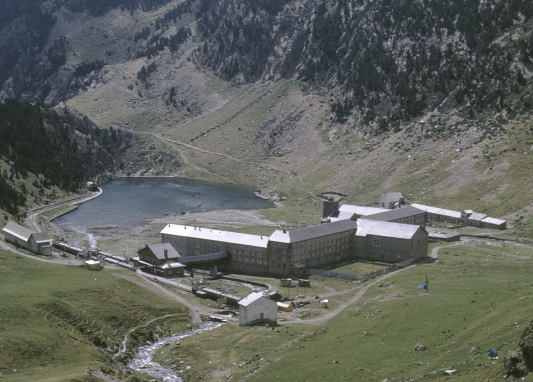
These bridges are part of Núria’s present-day landscape, but also of its history. The presence of two mountain streams bordering the sanctuary plain led to their construction, allowing processions, pilgrims and authorities to move around more easily.
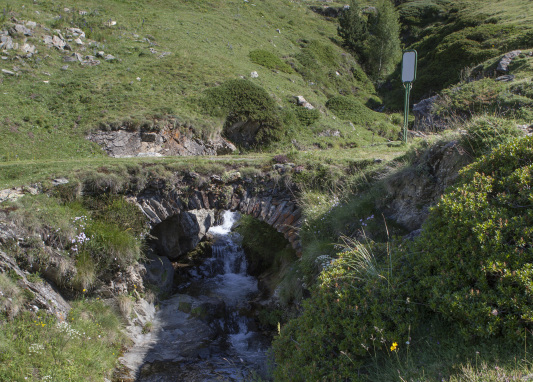
They date back to the Romanesque period, when the semicircular arch was the most common architectural form used in the doors and windows of monasteries, churches and castles. The origins of this style go back to Roman times, and it is believed to have evolved from false vaults. It was also the system used to build shepherds’ huts, where each new row of stone was placed slightly further inwards so that, when the structure was finally closed with a large slab, the whole construction became more solid.
To build a semicircular arch, a wooden frame known as a centring frame was first made, and the stone blocks, known as voussoirs, were placed on top. Held together by the pressure they exerted on one another, they remained firmly in place once the frame was removed.
Some of these bridges are still standing, while others have been replaced by bridges built using more advanced techniques and materials such as wood, iron, cement or concrete, and with shapes no longer based on the semicircular arch. Even so, in Núria the Romanesque semicircular arch was deliberately echoed by architect Josep Danés i Torres in various parts of the new sanctuary he designed and built throughout the 20th century.
Sant Gil bridge
Sant Gil was deeply fond of animals. He did not want anyone to harm them. On one occasion, he even saved the life of a deer that was being chased by a hunter.
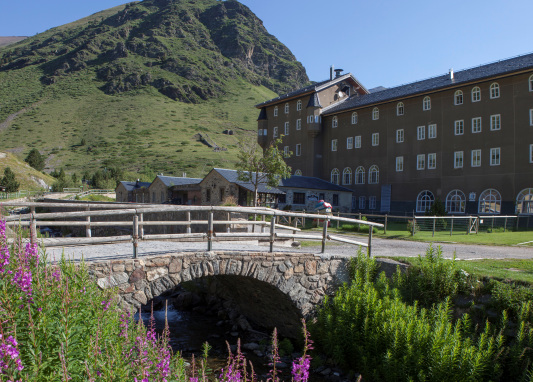
In Núria, Gil lived among shepherds and came to value the mountain dogs that watched over the livestock. He also saw other animals such as the Catalan donkey, which helped those shepherds in their daily work. When he was forced to leave Núria suddenly because of persecution, the saint hid the statue of the Virgin, a cross and a bell inside the cave of the chapel of Sant Gil. When these treasures were rediscovered centuries later, the shepherds carried them in procession from the saint’s chapel to the church, crossing this bridge over the Finestrelles stream.
Every year, on 1 September, that same procession is recreated on this bridge, commemorating the founding of the sanctuary. Anyone who crosses it begins a journey into the mysteries of Núria’s past.
RIDDLE: We have already seen that shepherds and pilgrims crossed this bridge, but animals did too. Can you work out which animal crossed this bridge in order to protect other animals?
CLUE: From here, head in the direction of 325° and walk as many metres as the number of years lived in the second millennium. You will find it behind you.
Sant Ignasi bridge
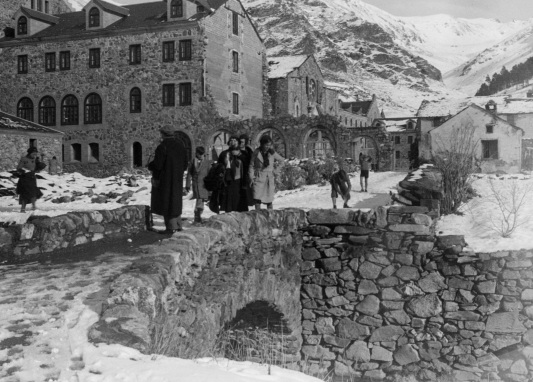
This bridge stands beside the place where Núria’s first essential services were established. First there were some wooden washing structures by the river, known as noc, used for laundry. There was also a small mill, later the building that housed the first café, dating from the final years of the 19th century, and finally the services linked to the rack railway. These services are one of the reasons why Núria remains accessible all year round, even during the harshest winter months. Thanks to the rack railway, Núria quickly became a well-known and popular ski resort, further strengthened by the founding of Club Alpí Núria on 26 December 1932, whose activity and presence were clearly visible from this bridge.
The name Sant Ignasi is a reminder of the Jesuit religious community founded by Saint Ignatius of Loyola. The Jesuits took advantage of Núria’s peace and quiet to hold Christian training courses and retreats here, including the famous Spiritual Exercises of Saint Ignatius.
Anyone crossing this bridge should remember just how important the rack railway and its associated services have been for Núria and for everyone who visits it.
RIDDLE: Life in Núria changed completely with the arrival of the rack railway. Do you know when that major turning point happened? In what year did the rack railway reach Núria?
CLUE: Look around you. Not far from here, and linked to the rack railway, there is a very basic hidden 4-digit number. Add 697 to it and you will have the answer.
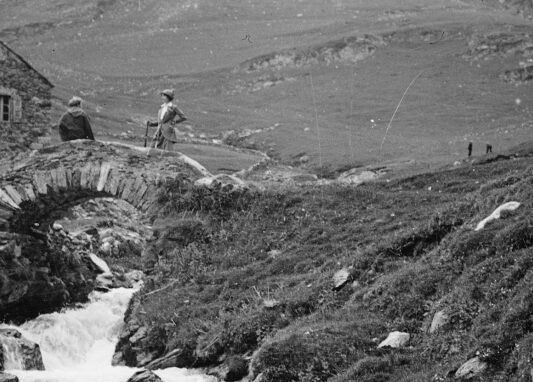
Mulleres bridge
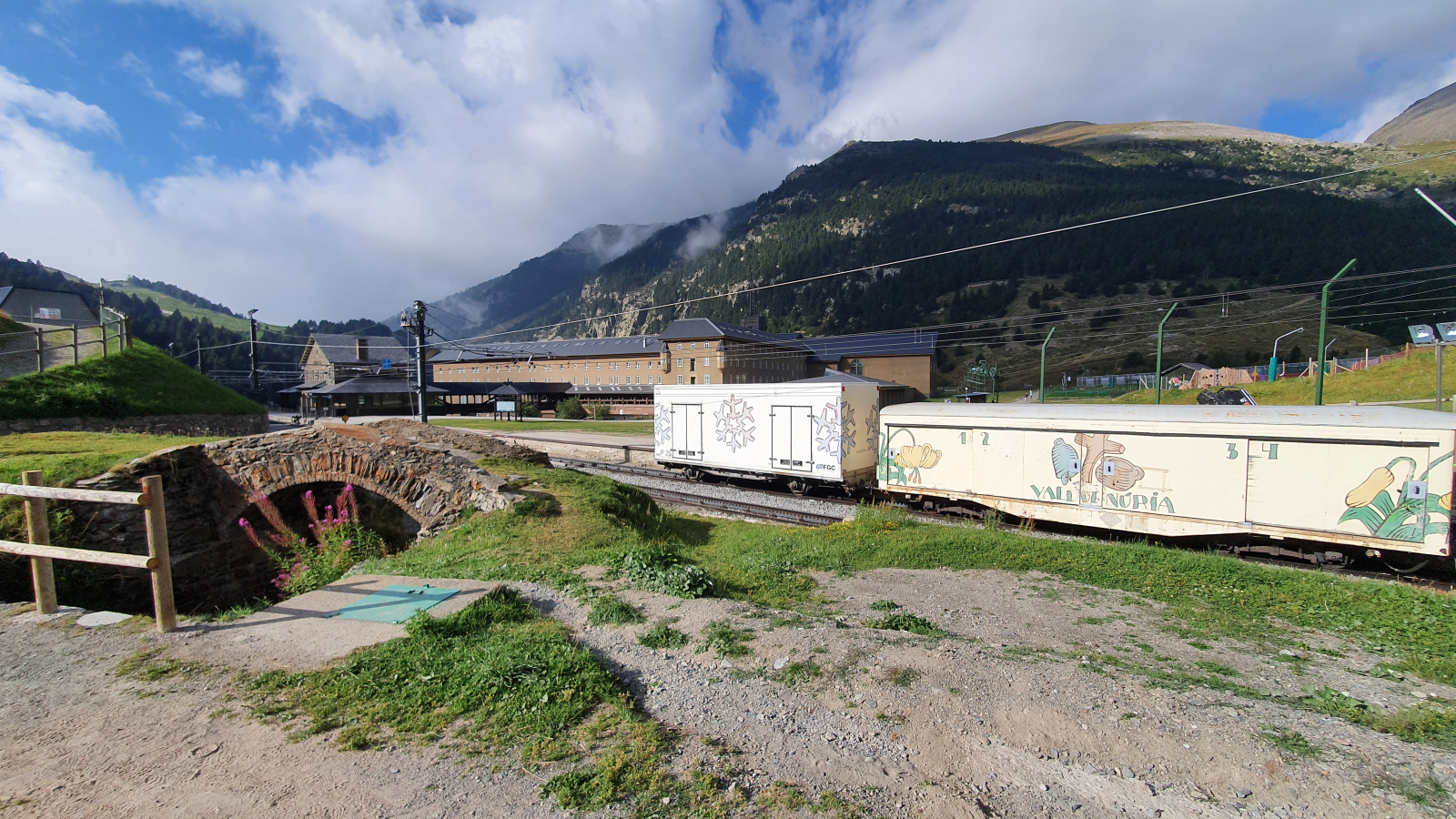
This bridge marks the start of several excursions from Núria following the course of the Nou Fonts stream towards the high peaks, where the vegetation and terrain begin to change and where hiking and close contact with nature can be experienced at their best. In the high mountains, everything changes. Rivers are very close to their source, they rush downhill along steep slopes, and they are usually known as streams.
The Mulleres stream, the Eina stream and the other streams of Núria are all tributaries of the Freser river. The need to come to Núria on pilgrimage from France or from the Camprodon valley, crossing these bridges, is already recorded in Francesc Marés’ History of Núria in the 17th century.
With the arrival of the 20th century, Núria would also witness the birth of hiking in Catalonia, first from a more scientific and humanist perspective, and later with a stronger social and sporting character.
Even if you only stop on this bridge for a moment, you can still imagine the grandeur and beauty of Núria’s mountains, admired with passion for so many years by hikers whose knowledge and experiences continue to bring wellbeing and inspiration to everyone.
RIDDLE: We have seen that scientists, shepherds, pilgrims and hikers often had to cross rivers and streams using bridges like this one. What do we call these watercourses?
CLUE: “You have to change the start of the current.” If you look at the shapes, you will see that the sign is the clue; you will find the letter you need.
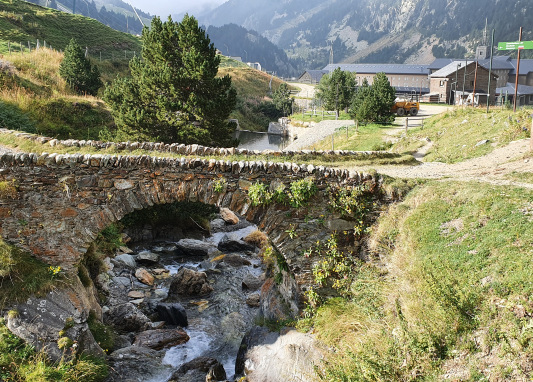
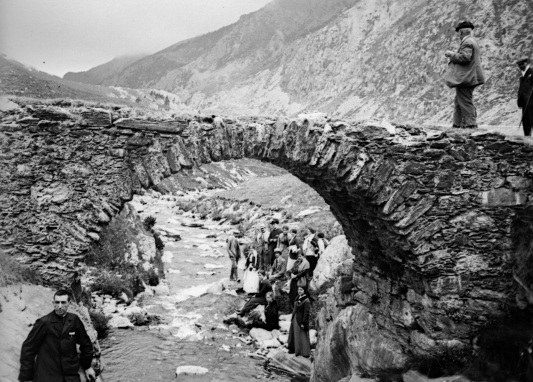
The Eina stream bridge
The Eina stream and the valley of the same name, which gives this bridge its name, evoke the memory of the many people who, in one direction or the other, used these mountain passes as meeting points between peoples and cultures, and also as escape routes towards freedom in times of persecution and war.
It is worth remembering, even if he may not have crossed this specific bridge, Father Ventura Carrera, who fled on foot to France carrying the statue of the Virgin. In doing so, he escaped certain death and saved the statue from the attacks and destruction of the Civil War that began in 1936. Three years later, this bridge and others in Núria leading to the French border witnessed the escape of many more people fleeing war, fanaticism and destruction. In times of war, many people have sought refuge and peace in the mountains.
But today, as always, a bridge like this also offers the chance to escape the routine of city life and reconnect with nature, as poets of Núria such as Verdaguer and Maragall so often remind us.
Pirinenques, Joan Maragall (1902)
High in the Pyrenees
the flowers are faded,
the flowers are pale blue,
bluish or purple:
sad are the mist-covered ridges
of the high mountains,
and sad the flocks
spread across the meadows,
and the upright figure
of the shepherd, alone.
The pale sun
gives neither colour nor warmth;
the poor, woody forest,
and the short, pale grass:
stony and grey
the mountain peaks,
all dotted with snow
in eternal white patches,
and smoking all around
the mist drifts and passes.
At dusk, from within the valleys
the mist begins to rise,
and wrapped within it
the high mountain withdraws in solemn silence.
Let us remember here, from this bridge, the freedom, purity and health of the mountains.
RIDDLE: If you have listened or read carefully, you now know that many of those who fled across this and the other bridges were looking for it, and today many people escaping the big cities for a while are searching for it too. What are we talking about?
CLUE: The animal that symbolises what it represents will never be found in these mountains; but if you listen to your surroundings, you will hear it.