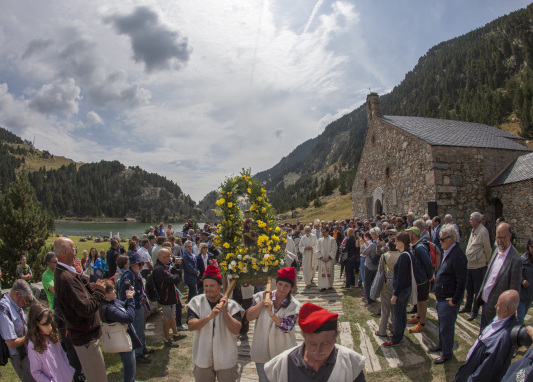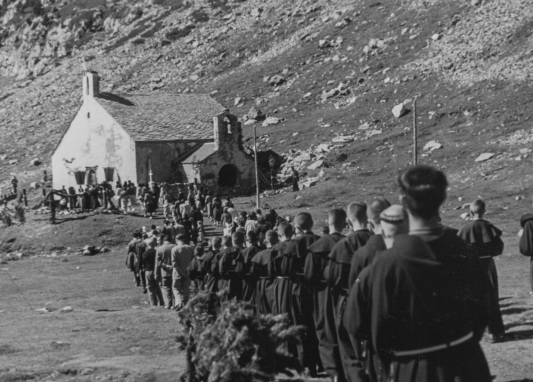


Follow a route with photographic viewpoints located in the most emblematic areas of Vall de Núria, between the Sanctuary and the lake.
Along the way, you will discover viewpoints and scenic corners ideal for capturing the valley from different perspectives, while learning more about the surroundings and their history.
A short and accessible route, designed to be enjoyed at a relaxed pace and to take home a visual memory of your visit.
Approximate duration: 25 minutes. Suitable for all ages.
1. Sanctuary
First chapel:
The legend of Sant Gil, which we will explore at point no. 5, tells how this saint carved the image of the Virgin of Núria and later had to hide it buried in a cave before fleeing due to persecution. Years later, it was discovered by the valley’s shepherds, giving rise to the devotion that continues today, with the first mass celebrated in 1079. However, according to legend, the construction of the first chapel is attributed to a pilgrim named Amadeo (year 1072).
Second chapel:
The earliest well-documented historical records of Núria, dating from the late 11th and 12th centuries, refer to the coexistence of two chapels: the original one built by Amadeo, and a larger one constructed in the centre of the Núria plain. References are also made to the domus hospitalis, a place intended to accommodate pilgrims and travellers. In later documents, this hospital or hostel—likely expanded—is referred to as Casa de la Volta, and records show it was not demolished until 1675 to make way for new buildings.
Old church:
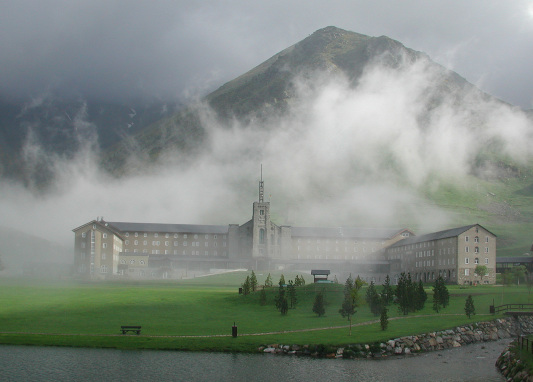
The growing number of devotees visiting Núria led, in the 17th century, to the construction of a larger church, attached to the north side of the previous chapel. Work began in 1639 and the church was inaugurated in 1642. Almost destroyed by an earthquake in 1829, it was later rebuilt.
New church:
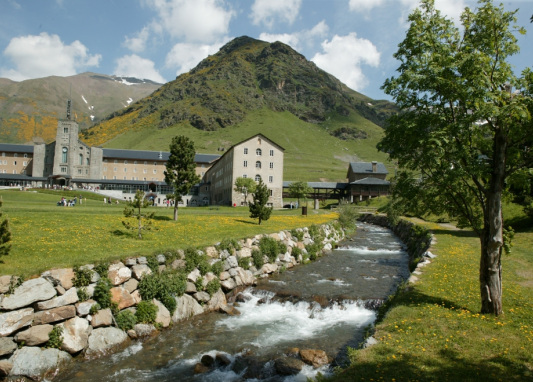
The need for a new, larger church was initially driven by Father Joan Salomó and the Bishop of Urgell at the time, Josep Caixal, who entrusted the project to architect Calixte Freixe. Construction began in 1883 and lasted 28 years, gaining significant momentum in 1907 under Bishop Joan Benlloch. The official inauguration took place on 8 September 1911. The originally planned neo-Gothic façade with two pointed bell towers was ultimately replaced by the current neo-Romanesque façade, completed in 1946, with a single central bell tower finished in 1964, which serves as the main entrance to the church.
2. Bridge and Rack Railway Station
Rack Railway:
From 1916 onwards, the Sanctuary remained open year-round due to the growing number of skiers and hikers. This led, in 1917, to discussions about the need to build a road or funicular to access Núria. The Bishop of Urgell, Joan Benlloch, and his successor, Justí Guitart, strongly supported this initiative. The rack railway option was ultimately chosen. Construction began in May 1928 and lasted three years, under the direction of engineer Montserrat Fenech i Muñoz. Although around 800 workers were involved, at certain points the workforce exceeded one thousand.
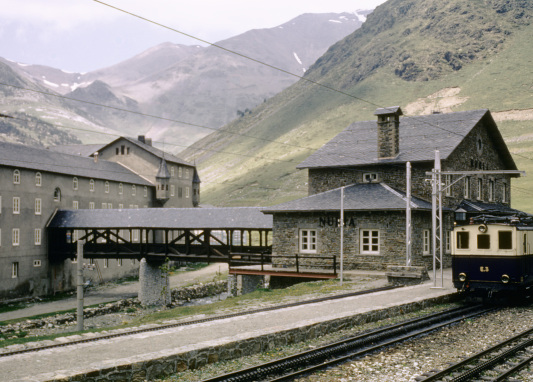
During construction, two steam locomotives from the Montserrat rack railway were used. After electrification, the Núria rack railway was officially inaugurated on 22 March 1931. With a maximum gradient of 15%, it features 9 bridges, 8 tunnels and 4 stations, the last of which—Núria station—was completed in 1953.
Architect Danés and the wooden bridge:
Architect Josep Danés was commissioned in 1921 by Bishop Justí Guitart to redesign the Núria plain, where service and religious buildings from different periods coexisted. His project included demolishing certain buildings to create an enclosed square featuring the Sanctuary façade and two large pointed towers. Ultimately, neither the enclosed square nor the towers were built.
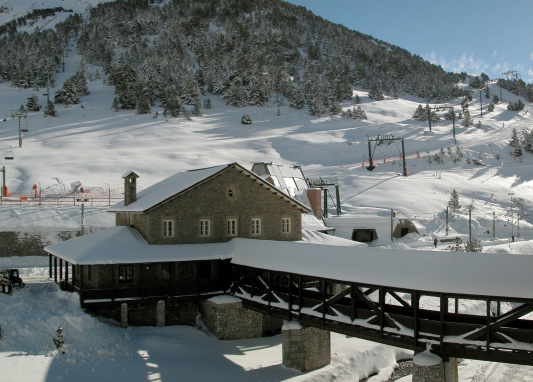
To connect the buildings with the station over the Mulleres stream, a covered wooden bridge made of pine and slate roofing was constructed. This highly characteristic bridge, inspired by Swiss mountain architecture, was influenced by the hospice at the Great St Bernard Pass and the bridges of Lucerne. It was inaugurated in 1933.
3. Font de l’Esquirol:
The rowan tree (moixera de guilla):
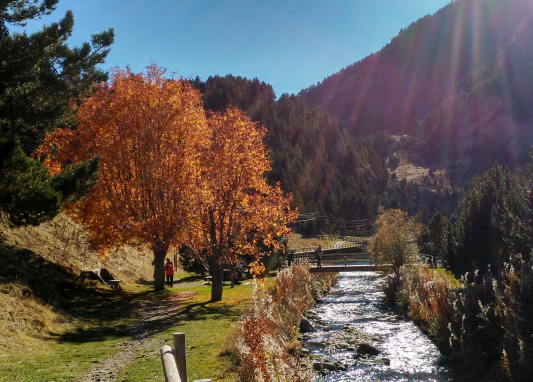
This species, native to Iceland, grows between 10 and 15 metres tall, with compound, alternate leaves and serrated edges. Its bark, grey and smooth when young, becomes darker and cracked over time. In spring, white flowers give way to red fruits as winter approaches.
These fruits give the tree its popular name, as foxes feed on them during winter when other food is scarce.
The Romans fermented them to produce a drink called cerevisa. Today, in Nordic and Eastern European countries, they are used to flavour certain types of vodka.
Its wood has also been valued for its durability, particularly for tool handles.
Font de l’Esquirol:
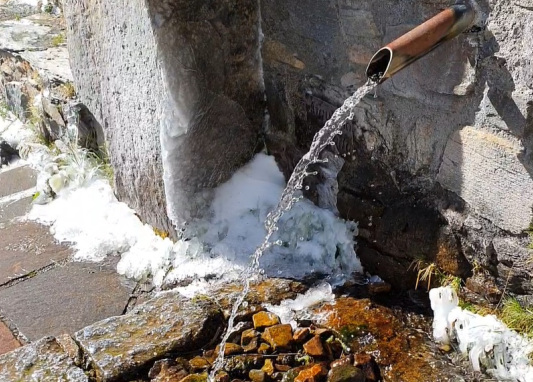
Traditionally, rack railway drivers would collect water from a small spring near the station switches. It is fresh, pure water flowing down from the forest of the Virgin. In the late 1990s, as part of environmental improvements, the current fountain and a picnic area were built, allowing visitors to enjoy this tradition as well.
4. Lake Viewpoint
Landscape and Tourism
The relationship between the landscape and its visitors was already present in the 17th century, when Francesc Marés broke with the dangerous and demonic view of the mountain to describe the plain of Núria as a heavenly approach. At the beginning of the 20th century, Joan Maragall also praised the charms of Núria in his hymns, highlighting the solitude of the surroundings. As Núria grew with devotees, the more pastoral image gradually gave way to pilgrims, with various service buildings and accommodations being added. Visitors arrived along different pilgrimage routes, especially from France, which enjoyed more advanced economic progress and therefore made leisure travel easier.
The architectural renovation of 1923 led by Josep Danés and his Alpine influence also brought changes to the perception of Núria, which were not always well received. Important aspects affecting the landscape, such as access to Núria, were debated, with discussions around whether it should be by road, funicular, or rack railway.
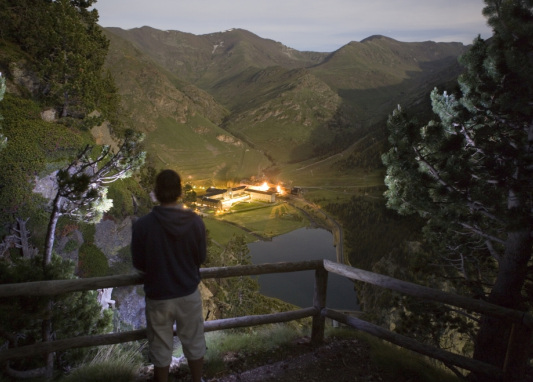
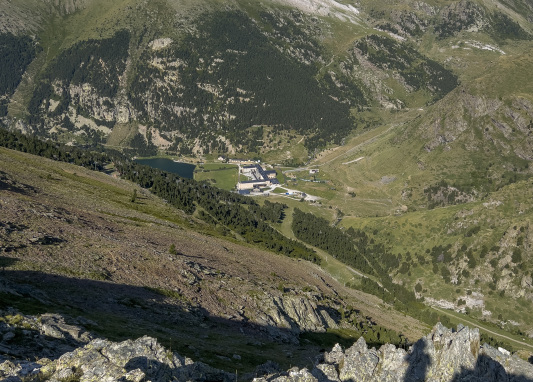
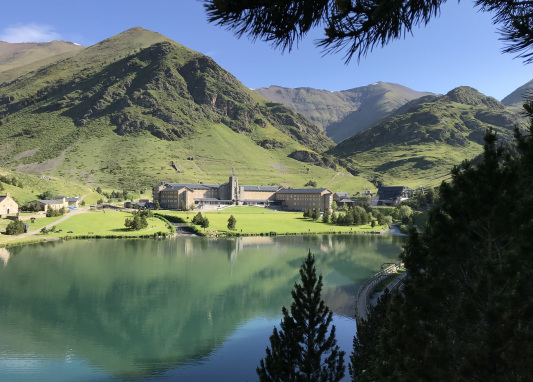
As early as 1912, a hydraulic project for the construction of a large dam was considered, which would have transformed the current landscape into a vast reservoir. Fortunately, only the current dam was built in 1956, creating a leisure space and the majestic mirror effect on the water that we can admire today.
In the 1980s, there were also expansion projects for the ski resort towards Puigmal, which were ultimately not carried out. Since 1984, the management of FGC has always been focused on preserving the natural environment. In the early 1990s, the current landscaping of the surroundings of Núria was developed, always seeking a balance between facilitating access and respecting the environment.
Each generation has been a modifier of the landscape: from the first Neolithic shepherds making use of caves, to Amadeu with his chapel, or the counts of medieval Catalonia managing pastures. Always seeking the use of the meadows, religious connection, or enjoying hiking since its origins; all that remains for us is to continue placing respect for the natural environment and historical heritage above all else.
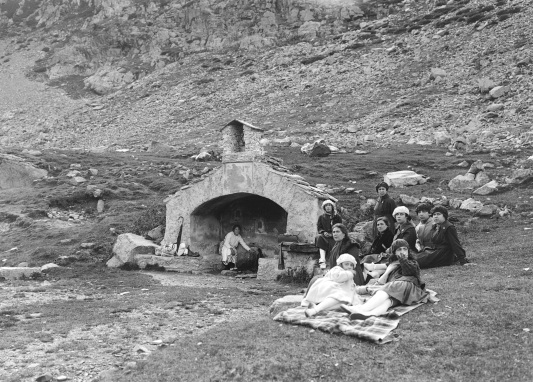
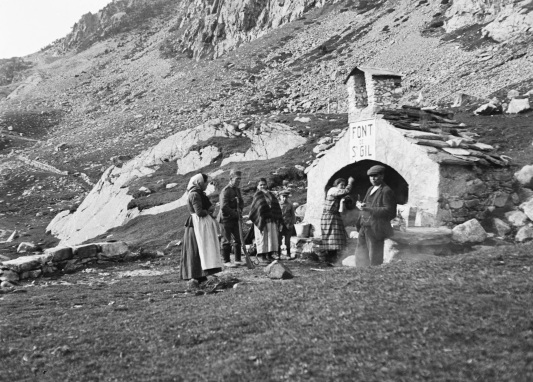
5. Sant Gil Fountain
Although originally from Athens, legend says that around the year 700, Sant Gil arrived in Núria from Provence, where he had founded a monastery. His goal was to attain the peace and tranquility of an eremitic life. Sant Gil spent his days devoted to prayer and to creating his own icons, among them the image of the Mare de Déu de Núria. It is said that when Sant Gil arrived in the valley, he had already brought the cross with him.
The saint stayed in a cave that now bears his name and devoted part of his time to living alongside the shepherds who brought their livestock to graze in the meadows of those mountains. With them, he shared his food: a little grain and broad beans cooked in a copper pot. When the meal was ready, Sant Gil would ring a bell to call the diners.
Sant Gil’s stay in these valleys filled with snow and water lasted only four years. Pursued by various conflicts, Sant Gil had to leave quickly and return to Provence.
Before leaving, however, he hid his small treasure: the image of the Mare de Déu, accompanied by the three objects that later became symbols of Núria: the bell, the cross, and the pot.
6. The Mountains of Núria
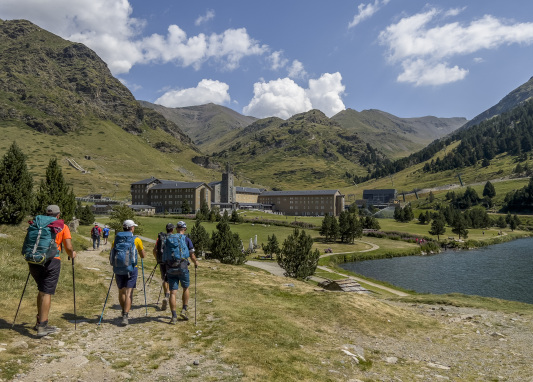
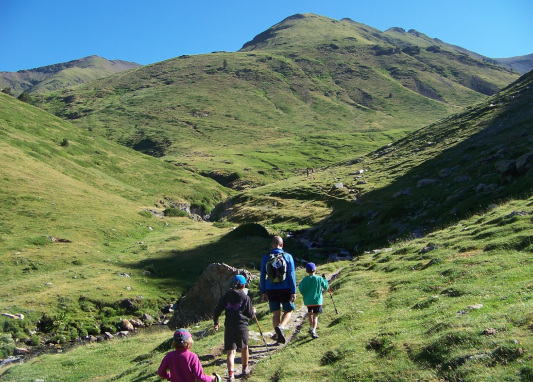
Núria is located in the heart of the high mountains of the Pyrenees. The Sanctuary stands at almost 2,000 metres above sea level, at the point where three valleys meet: to the west lies the Vall de Finestrelles, with the subsidiary valley of Coma de l’Embut; to the north, the Vall d’Eina; and to the east, the Vall de les Molleres, formed by the valleys of Noucreus and Noufonts.
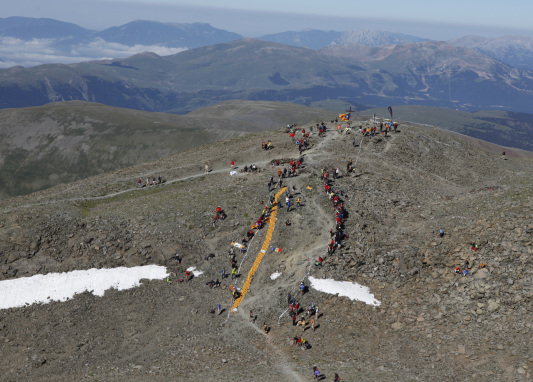
The combination of all these valleys forms a mountainous basin surrounded by a long and high semicircular ridge that closes it off to the east, north, and west above 2,700 metres, known as the Olla de Núria, with its highest point at the summit of Puigmal, at 2,913 metres. To the south, a steep and elevated rocky barrier encloses the entire valley system.
Hiking emerged in Catalonia during the second half of the 19th century, in its early stages combining scientific and cultural objectives, and gradually evolving into the current model that includes sporting, cultural, and natural dimensions. Vall de Núria is considered the cradle of hiking and a learning base for countless mountaineers and alpinists who have gone on to make great ascents in mountain ranges around the world. An extensive network of trails allows visitors to enjoy the valley, whatever their level or objective may be.
7. Dr. Bassols Fountain
The history of Núria has always been linked to one figure or another who left their mark on the valley, whether through their role or their devotion. From Sant Gil and Amadeu, the protagonists of the legend of Núria, to the present day, the list is countless, spanning more than a thousand years of history.
We certainly have more information from the modern era, as there is more written documentation, but people who felt drawn to Núria and made it a central part of their lives can be found in every period. One example is Francesc Marés, with the publication of his book Història i miracles de la sagrada imatge de nostra senyora de Núria in 1666.
In the 20th century, Bishop Joan Benlloch was a determined driving force behind the completion of the new temple inaugurated in 1911, and he also promoted the commission for new access to Núria. He was followed as head of the bishopric of La Seu d’Urgell by Bishop Justí Guitart, a devoted admirer of Núria and the architect of the current Sanctuary, who promoted the demolition of the old buildings for a new project entrusted to another essential figure, Josep Danés. He was the architect who shaped the Pyrenees with an architecture inspired by the Alpine valleys.
Engineer Montserrat Fenech led the colossal project of constructing the rack railway, completed in 1931. Priest and historian Fortià Solà also carried out significant work related to Núria. Another priest, Mossèn Bonaventura Carrera, took the Mare de Déu to France through the Coll de Finestrelles to protect it from what was almost certain destruction by fire at the beginning of the Spanish Civil War.
Others may not have been as prominent, but they are still part of the Nurian landscape, giving their names to small enchanting places, such as the Pont de l’Escudé in the Vall de Noucreus, named in honor of one of the valley’s first mountain guides.
8. Sant Gil and Dr. Tarrés Fountain
The Hermitage of Sant Gil was built in 1615 and is currently the oldest building in the valley. The voussoir above the entrance, which bears the inscription 1644, should not be misleading, as it belongs to the old church; when the church was demolished, it was preserved and placed in the Hermitage of Sant Gil.
At the beginning of the Spanish Civil War, many ecclesiastical symbols were destroyed, such as the wooden altarpiece that stood in the Sanctuary, as well as the hermitage itself, which was burned and destroyed. In 1951, through an admirable popular campaign, letters were sent to all the people named Núria, inviting them to make a contribution by paying for a brick or a stone that would bear their name engraved for posterity. Everyone collaborated, including the mass media. With the restoration of the Chapel of Sant Gil, Núria recovered one of the spaces that formed part of its symbolic and mythical landscape.
It underwent its most recent restoration in 1999, leaving it as we see it today.