


THE WATER CYCLE
A Reuse Project
When the winter season ends, temperatures begin to rise, the days grow longer, and the snow that has accumulated at our resorts begins to melt. The water cycle never stops.
Melting is the process by which snow and ice in the mountains turn into liquid water due to rising ambient temperatures. This process is part of the water cycle, a natural phenomenon that describes the continuous movement of water between the atmosphere, the Earth’s surface, and bodies of water. The water cycle includes several main processes:
EVAPORATION
Water from the oceans, lakes, rivers, and soil is heated by solar energy and turns into water vapor, rising into the atmosphere.
CONDENSATION
Water vapor in the atmosphere cools and condenses to form clouds.
PRECIPITATION
Water droplets in the clouds grow until they reach a sufficient size and fall to the Earth's surface in the form of rain, snow, hail, or sleet.
SURFACE AND GROUNDWATER RUNOFF
Rainwater can flow over the earth's surface and end up in streams, rivers, and lakes, or it can seep into the ground and move through it as groundwater.
A BIOCLIMATIC BUILDING AT AN ALTITUDE OF 2,000 METERS
The snow we produce at our resorts comes from this natural water cycle, and we only use it to change its state (from liquid to solid and from solid to liquid). This artificial snow facilitates the formation of a layer of ice in contact with the ground, which helps preserve the snow from natural snowfall for much longer. At the same time, this manufactured snow slows down the entire melting process, allowing the water to reach the reservoirs later, which is beneficial for the water cycle.
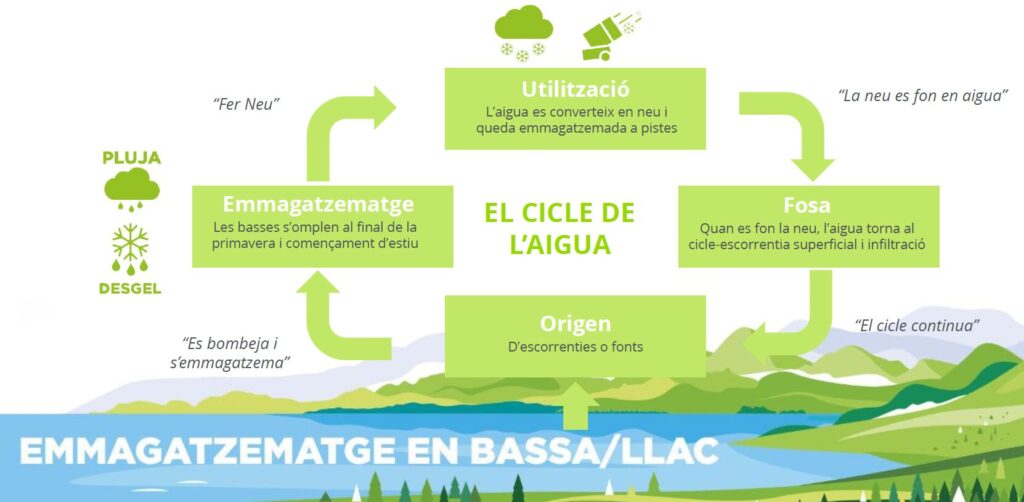
In addition, we work season after season to ensure that our operations are as sustainable as possible. Our technology runs on green energy and, combined with the specialized software we use for snowmaking, this allows us to make much better use of weather conditions and operate more efficiently.
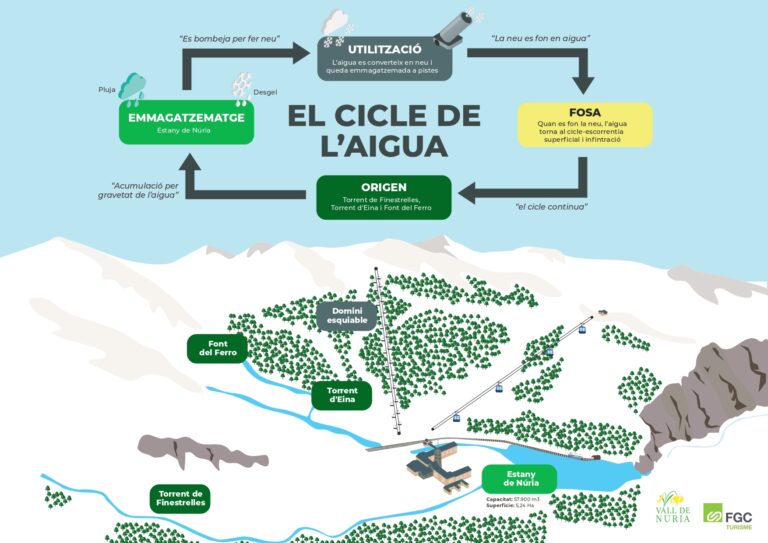
As a new development, at our mountain resorts, we have upgraded the nozzles on our snowmaking equipment to optimize the process using less water and during periods of milder weather.
We are firmly committed to sustainability, which is why we are promoting unique global initiatives such as the Snow Laboratory, where FGC Turisme resorts will serve as test sites to simulate the natural process of water mineralization on a small scale with the goal of producing snow more efficiently. The project is a collaboration between FGC, the Barcelona Institute of Materials Science (ICMAB–CSIC), and TechnoAlpin, with the expectation of replicating the positive results obtained in the laboratory over the course of the three-year project.
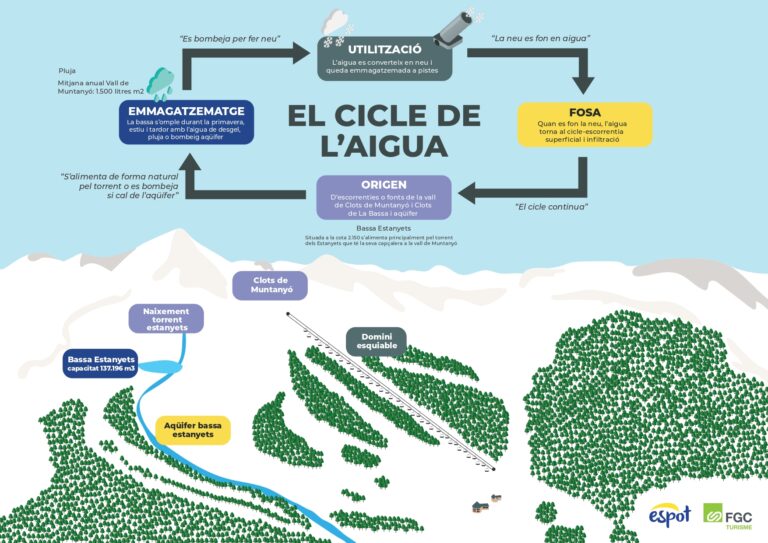
The winter season is coming to an end, but the work to become more sustainable and adapt to climate change continues at FGC Turisme. With the end of the snowmelt and the start of summer, our teams have already begun working on strategic initiatives that will have a significant impact on the stations, such as track maintenance, the removal of infrastructure, and reseeding.