


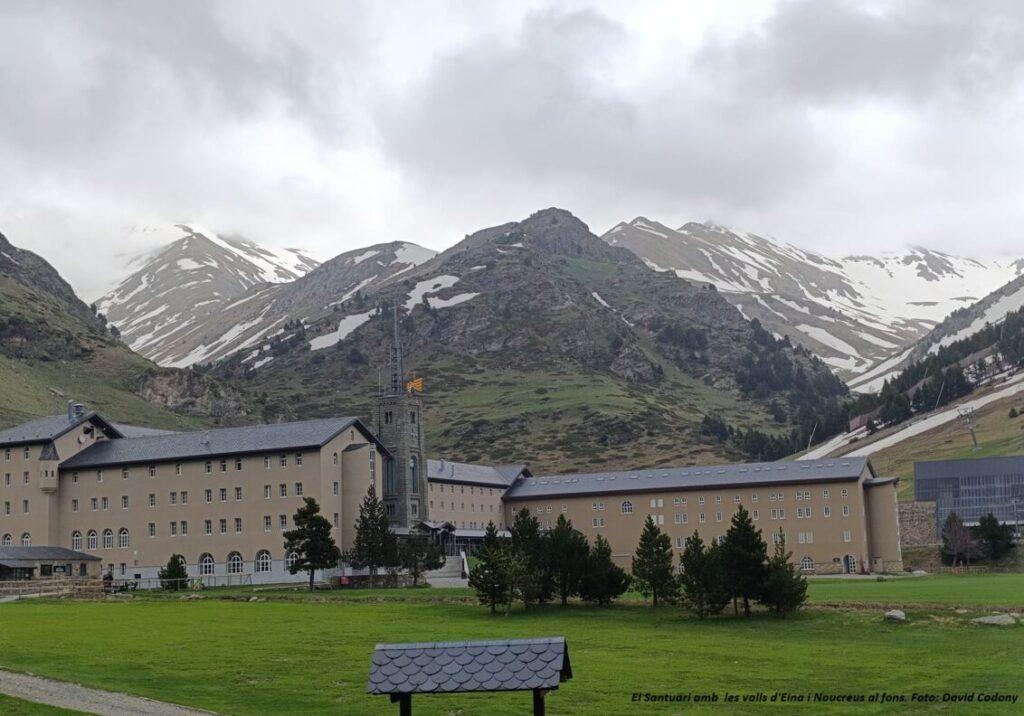
We are still in this situation, where it seems the mountains are now easily accessible; however, there is still quite a lot of snow on all the north-facing slopes. Ski mountaineering and mountaineering are both perfectly feasible. There is a very significant difference between south-facing and north-facing slopes.
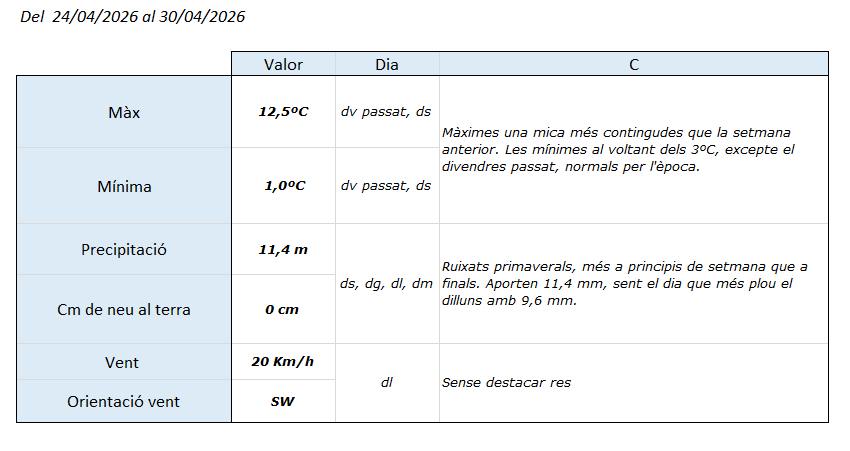
Summary of weather data at 2.000 m:
Forecast: (meteomuntanya.cat and @meteocattv)
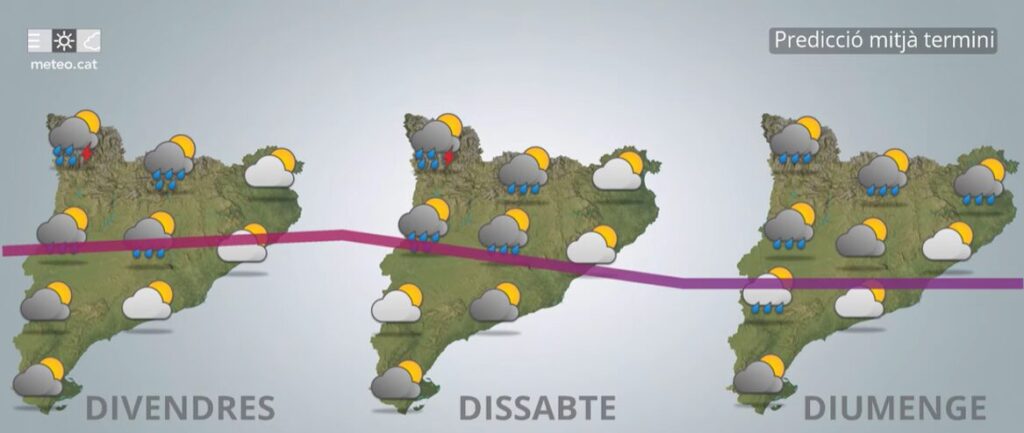
Unstable weather is expected, with a chance of thunderstorms and showers in the afternoon.
Snowpack:
We are seeing a return to continuous snow cover at higher altitudes, from 2,100 metres upwards and on north-facing slopes; on south-facing slopes, the snow has already receded almost all the way up to the summits. The snow is very spring-like; bear in mind that, although it is not freezing, the surface is still hardened due to the internal temperature of the snowpack and the humidity. Depending on the daily temperature, the point at which the snow turns to slush will vary in terms of time of day and depending on the slope.
Remember that spring snow poses risks in the morning due to the risk of slipping on hard snow and ice. However, once the sun hits it during the day, the surface layer melts, making for a pleasant ski. Whatever activity we’re planning – be it ski mountaineering, snowshoeing or mountaineering – we must carry essential equipment such as an ice axe, crampons and a helmet. With such high temperatures, it’s best to set off early to enjoy the snow before it becomes completely saturated and makes skiing difficult, particularly on south-facing slopes and at lower altitudes.
Today, Thursday, the risk level is 2/1 out of 5. This is mainly due to basal and snowmelt avalanches on south-facing slopes, particularly during the middle of the day or during showers. Please keep an eye on the information in the Avalanche Risk Bulletin. Don’t forget to bring safety equipment such as a shovel, avalanche transceiver and probe.
At this time of year, there are two main routes available for winter hiking. Firstly, the Coma del Embut route, where you’ll need to walk for 15–20 minutes until you reach the stream below the Forat del Embut, from where the path continues all the way to the summit.
The other route is the main route through the Noucreus valley, which we can follow from the Mulleres forest, a 5-minute walk from the Sanctuary, without having to take our skis off at any point, apart from a few short sections between snowdrifts. From here, we’ll reach Noufonts, covering the entire northern slope with the Carançà valley, Coma de l’Infern, Font Negra, etc.
The route up Puigmal via Fontalba can be completed with hardly any snow. Take crampons along for safety’s sake, but the few patches of snow you’ll encounter can be easily avoided. The track is in good condition.
We found the Camí Vell completely clear of snow. It can be walked without any problems other than the weather conditions on the mountain itself. At one point, there is a fallen tree to navigate around.
You can drive all the way up to the pass at Fontalba. Due to its orientation, the path leading to Núria passes through two north-facing sections of woodland that are covered in snow. If you set off early in the morning, the high altitude of the path means you will encounter hard-packed snow. In this case, flexible crampons will prevent any unwanted slips. NOT RECOMMENDED for people without winter experience and the appropriate equipment.
On the Enginyers trail, although we can’t see any snow in the distance, it’s important to bear in mind that it crosses two deep gorges where there isn’t much sunlight. We’ll come across snowdrifts that could make the going very difficult.
You must bring crampons and should not hesitate to put them on, however short the section may be. The steepness of the route leaves no room for error. This route is NOT RECOMMENDED for those without winter experience and the appropriate equipment.