


The nice weather is finally here. Starting Thursday, the weather has completely changed, with sunny days and temperatures above the seasonal average. Take advantage of this to get out and be active, but keep in mind that there is still a lot of snow at higher elevations. Watch out for afternoon thunderstorms forecast for the end of next week.
Summary of weather data at 2.000 m:
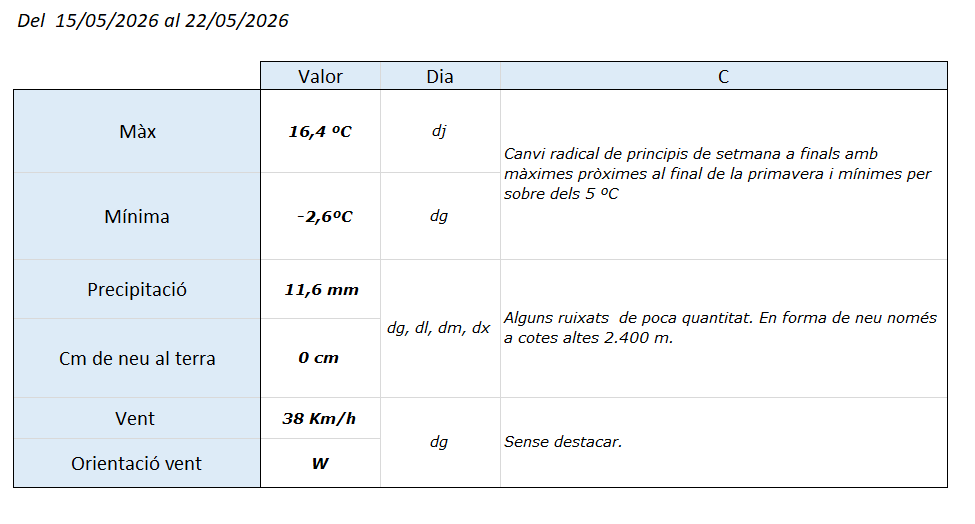
Forecast: (meteomuntanya.cat and @meteocattv)
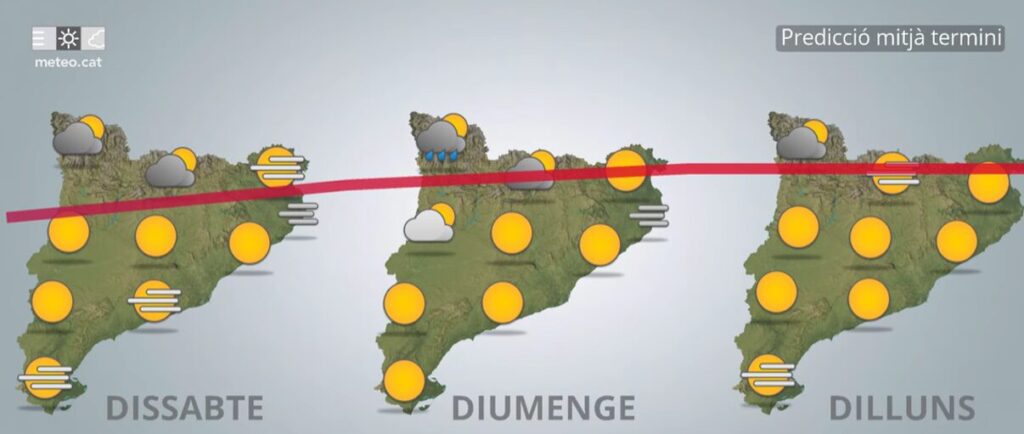
A significant rise in temperatures.
Snowpack:
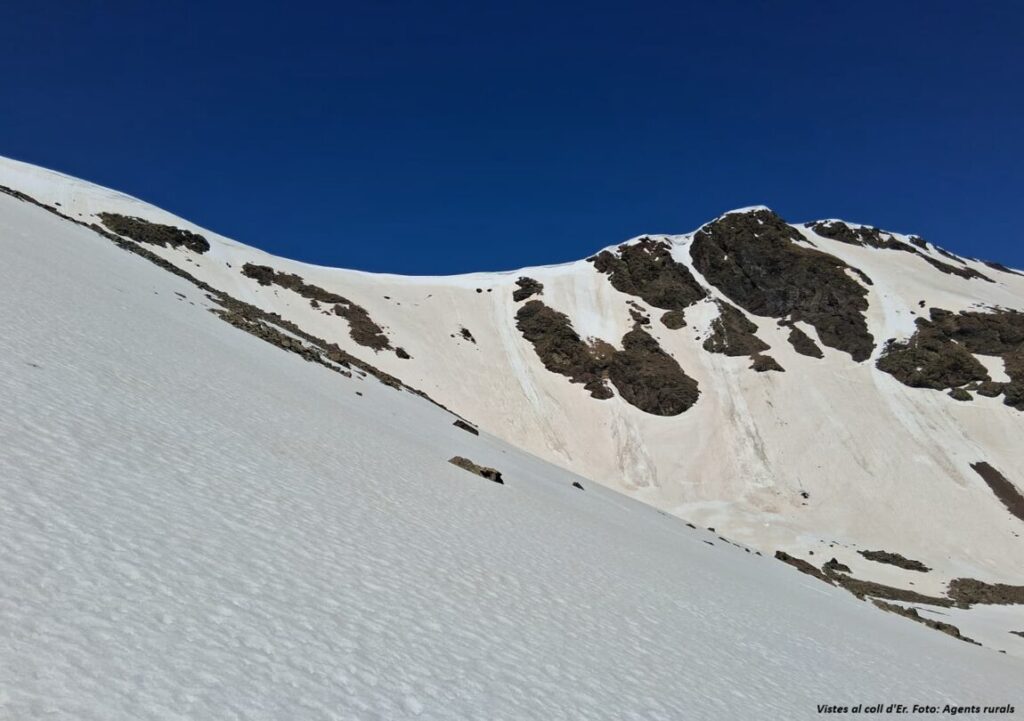
As was the case last week, we still haven’t found a truly continuous snowpack, but on shaded slopes and above 2,400 meters, there is enough continuity to plan routes on skis or snowshoes on the main peaks. The sunny slopes have scattered snowdrifts. The current rise in temperatures suggests that the final chapter of the snow season in the mountains is beginning. There is little refreezing at the 2,000-meter elevation, and the snow is rapidly transforming as the morning progresses.
Remember that spring snow poses risks in the morning due to the risk of falling on hard snow and ice. However, once the sun hits it during the day, the surface layer melts, allowing for a pleasant ski experience. Regardless of the activity we plan to do—whether ski mountaineering, snowshoeing, or mountaineering—we must carry essential gear such as an ice axe, crampons, and a helmet. With these high temperatures, it’s best to set out very early to enjoy the snow before it becomes completely saturated and makes skiing difficult, especially on south-facing slopes and at lower elevations. As of today, Friday, the avalanche danger level is now classified as “general,” with no specific numerical risk rating. The focus remains on the hottest parts of the day and on sunny, steep slopes. Be sure to follow the information in the Avalanche Danger Bulletin. Don’t forget to bring safety equipment, such as a shovel, avalanche transceiver, and probe.
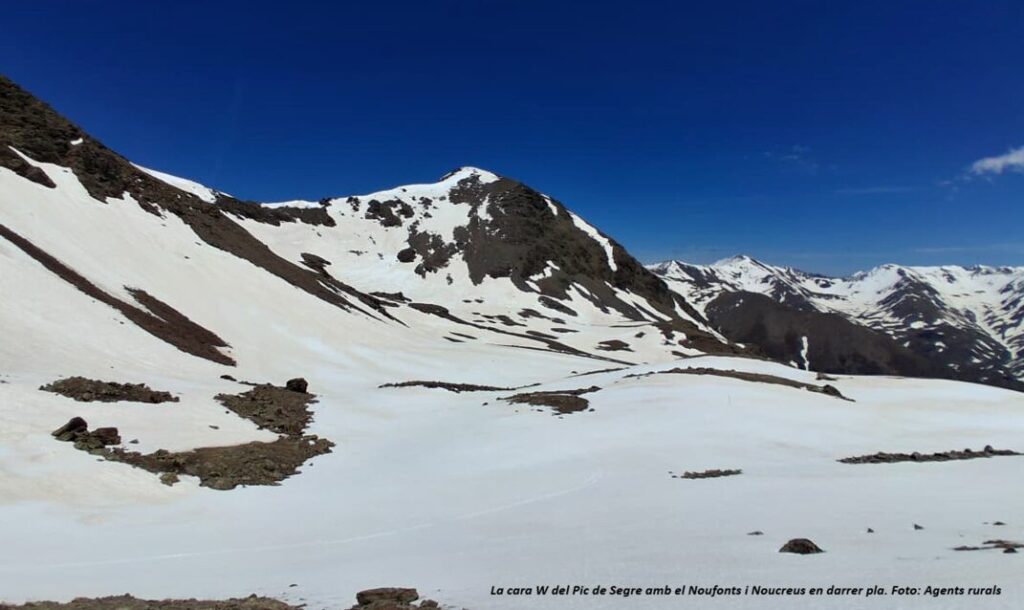
The main areas with enough snow for backcountry skiing or snowshoeing are Coma de l’Embut and the Noucreus Valley. On one hand, Coma de l’Embut, where you’ll need to hike for 20–25 minutes to reach Forat de l’Embut, from which point the trail continues all the way to the summit, except for a few short, fan-shaped sections before crossing the stream.
The other route follows the main path through the Noucreus Valley, which we can follow on foot for 20–25 minutes until just past the Pont de l’Escudé, then the snowline of the stream that will take us to the heavily snow-covered Noucreus slope and allow us to cross over to the entire northern slope with the Carançà Valley, Coma de l’Infiern, Coma de Vaca, Font Negra, etc.
On the Puigmal trail via Fontalba, there are once again some snowdrifts on the final stretch; given the elevation, the snow may be hard in the morning. It’s best to bring safety gear. The trail is accessible.
The trail from Fontalba to Nuria is no longer difficult due to the lack of snow. However, you’ll need to be careful in case this weather front brings snow. Remember that the entire route is above 2,000 m. Carrying crampons in your backpack will prevent any unwanted slips. NOT RECOMMENDED for people without winter experience and the proper equipment. You will need to cross a snow-filled gully from a recent avalanche and a few trees that have been blown down by the wind.
The Camí Vell is now completely clear of snow. You can hike it without any problems other than the usual mountain weather conditions. At one point, there is a fallen tree that you’ll need to move out of the way.
Although there is no snow in sight along the Enginyers Trail, keep in mind that it crosses two deep ravines where the sun doesn’t reach very often. We will encounter remnants of snowdrifts that can make the passage very difficult. You must bring crampons and not hesitate to put them on, no matter how short the section. The steepness of the terrain leaves no room for error. NOT RECOMMENDED for people without winter experience and the proper equipment.