


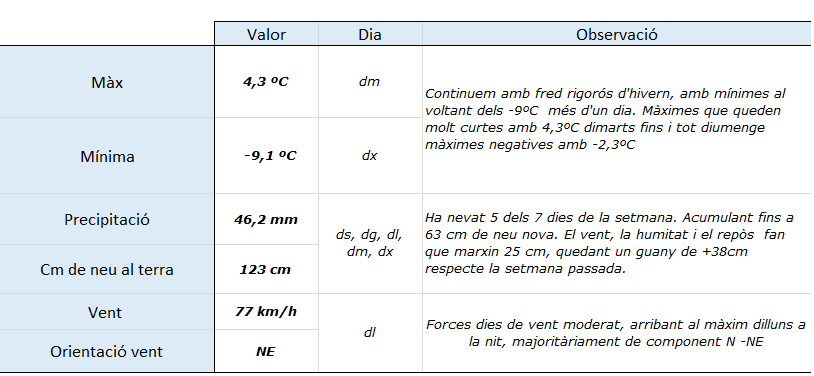
New snowfalls have finally brought the highest snowpack on the ground since records began from the automatic weather station. It remains to be seen whether this will also be the case with data from previous years from the manual station, or with older records.
Summary of weather data at 2,000 meters:
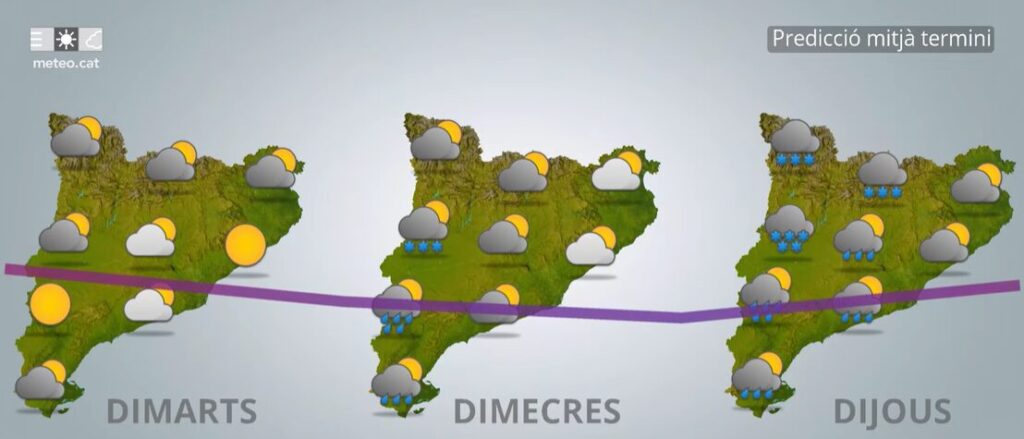
Forecast: (meteomuntanya.cat and @meteocattv)
Snowpack:
The purpose of this blog is to inform you about the location and condition of the snow in our valleys, providing you with an additional tool for planning your outings. Currently, it’s possible to travel almost anywhere; the limiting factor this season is the risk of avalanches. Now more than ever, it’s essential to evaluate your routes based on the information you receive.
Around the Sanctuary, we’re already finding it difficult to find places to put the snow we clear to facilitate daily maintenance. Up in the mountains, the snow accumulations are increasing, and although it’s been a fairly windy week, the higher elevations and some ridges are showing signs of wind damage.
A week of intense cold has resulted in good snow quality. Today, Monday, temperatures are rising and dampening the snowpack. The forecast predicts more snow this morning… Overall, there’s a lot of variability. The dampening of the snowpack helps it settle if frost follows; but it also increases the density of the upper layers, making it easier for snow to fall during the first few hours after a wet snowfall.
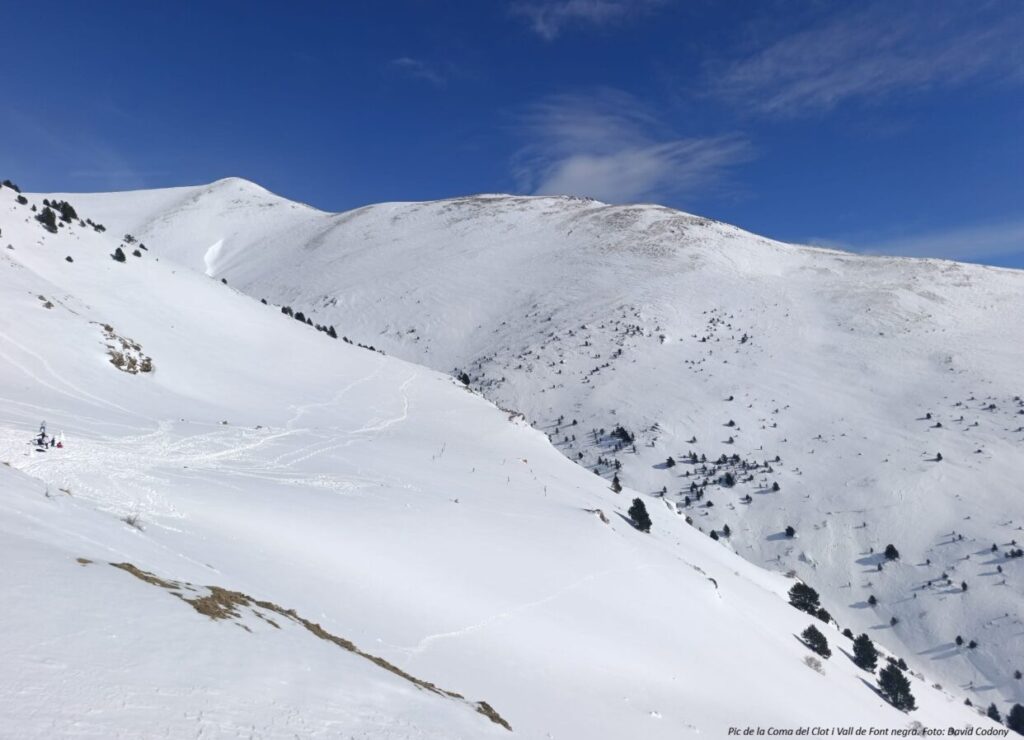
The snowpack is continuous and thicker than usual for this time of year, starting at 1,400 meters on the north-facing slopes and 1,600 meters on the south-facing slopes. It has snowed quite a bit again this week, approximately 63 cm of new snow, with daily accumulations of fresh snow. Winds from different directions—south, west, and north—have formed new snowpacks on all aspects. Today, Monday, it rained and the conditions became quite damp.
It is essential to pay close attention to weather forecasts and avalanche risk predictions. The current risk level is 3 out of 5. Remember that if you are caught in an avalanche, the most important thing is to reach those affected as quickly as possible.
Therefore, we ourselves can carry out this rescue, provided that the avalanche equipment is brought: DVA, shovel and probe.
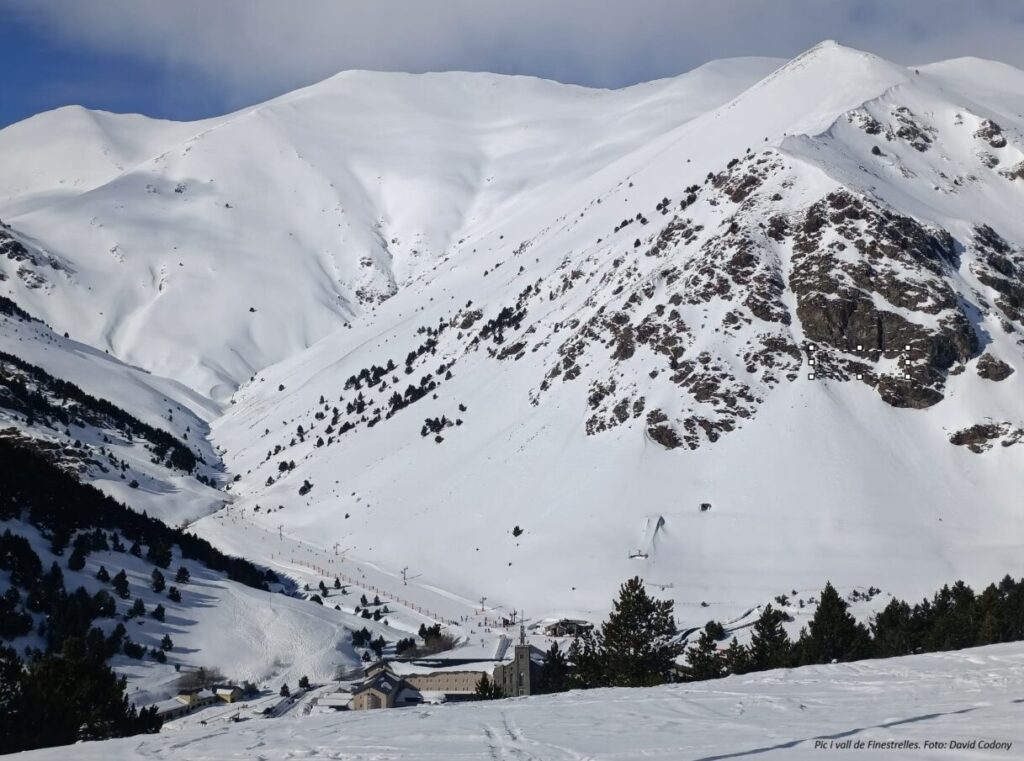
On the Camí Vell, snow is found above 1600m, shortly before the Cremal bridge. The current snow accumulation at the top of the trail creates conditions suitable for mountaineering. Furthermore, depending on the snowfall, avalanche prevention measures are being carried out, resulting in the closure of the Fontalba and Camí Vell trails.
Fontalba is inaccessible by car due to snow accumulation. The path to Núria is in mountaineering condition. It is NOT RECOMMENDED for people without avalanche knowledge or the appropriate equipment. This path is exposed to avalanches; it is NOT RECOMMENDED.
The Engineers‘ path is covered in snow and is not recommended throughout the winter season due to areas where a slip can have fatal consequences.